Showing posts with label drawing. Show all posts

Thursday, February 08, 2018

sketching (Fortuna)

This drawing is about Fortuna, the goddess of luck and fortune. She’s inspecting, ensuring that I’m truly invested in what I do, guarding against anything that might feel insincere or shallow.

I began this sketch in Berlin, but it wasn’t until after my sabbatical year in South America that I finally had the opportunity to continue it. When I arrived in Paris and stayed at my mom’s place, I knew it would be a challenging time. To balance the stress, I decided to meet with a few collectors—friends of Monsieur Pablo Guayasamin. The only thing I knew about them was that they owned a Gallery near Saint-Germain-des-Prés.


Fortuna’s Embrace (Sketch)
Acrylic, Ballpoint pen, Gold on Paper
2017 - 2018


What I hadn’t anticipated was that these collectors were genuine art enthusiasts. They were so kind and welcoming that they invited me to exhibit in their gallery. After our meeting, I rushed off, and as the rain began to fall, I took refuge in the first café I found. 

As I waited for my coffee—those moments of quiet often spark my creativity—I continued working on the pointillism phase of my sketch (if you follow my blog, you know that many of my ideas come to life during these pauses, simply while waiting for my coffee).


Wednesday, January 17, 2018

T4

T4 is the first piece in a series of drawings that explore the complex and contradictory nature of human existence


(UPDATE: Just before the onset of the pandemic)


"T4"
Ink, Watercolor and acrylic on paper ,
2378 x 1680 ,
2015/2016


Our species, much like cancer cells, multiplies rapidly and consumes resources without regard for the well-being of our host—Earth itself. The effects of our relentless growth and insatiable consumption are becoming increasingly evident, and now we even entertain the idea of colonizing other planets.


However, this destructive behavior is not an inherent flaw of humanity. Rather, it results from the absence of natural limitations that might have once regulated our growth and reproductive impulses. As an artist, I feel compelled to explore and portray these uncomfortable truths about our species, in hopes of sparking awareness of the harm we're causing. T4 is a powerful visual representation of this urgent message."


T4 from meyoko on Vimeo.

Monday, December 12, 2016

Julunggul


A few days ago, Magnus Johansson from the band Smallfunk, an exceptionally talented musician from Sweden, reached out to ask if I would be interested in collaborating on his next album. 

He explained that the album would be a tribute to both his dear friend and to the vibrant spirit of Africa. From the moment he mentioned Africa, I felt an immediate connection — the word alone brought a smile to my face, and I was inspired to dive into its symbolism.


I began by collecting flowers endemic to Africa, selecting those that resonated most deeply with me. These flowers became the core of the design — symbols of life, growth, and the continent’s natural beauty. 

As I worked, I felt compelled to incorporate elements of religious symbolism, inspired by the well-known Biblical imagery of Adam and Eve. With the album's title, Afrodisiac, in mind, I approached this symbolism with a contemporary twist, exploring themes of innocence, temptation, and the evolving nature of desire. In my interpretation, Eve becomes the apple — a symbolic gesture that reflects both the title and the sensuality at the heart of the album.

The result is an artistic exploration that blends the sacred with the sensual, inviting a re-examination of these themes through an African lens, while honoring the cultural and spiritual nuances of both traditions.


 Check out the album here


Julunggul

The Rainbow Serpent, or Rainbow Snake, is a revered deity in Aboriginal mythology, often seen as the Creator God.


Known by various names across different Aboriginal languages and cultures, this sacred being is a powerful symbol in both art and religion.  Like an archetypal mother goddess, the Rainbow Serpent shapes the land and fosters diversity, yet when disturbed, it can unleash great chaos.

While not all myths depict the serpent as a snake or connect it with a rainbow, the presence of water or rain is almost always central. When a rainbow arcs across the sky, it is said to signal the movement of the Rainbow Serpent from one waterhole to another. This divine imagery explains why some waterholes never run dry, even in times of drought.

Thursday, December 08, 2016

"Nephila"


"NEPHILA "

Ballpoint pen, graphite,


 "NEPHILA "

Ballpoint pen,graphite,acrylic.

"the blind series"

2016  


Wednesday, July 20, 2016

"ANAMNESIS"

Anamnesis is a concept in Plato's epistemological and psychological  theory that he develops in his dialogues Meno and Phaedo, and alludes to in his Phaedrus. 

It is the idea that humans possess knowledge from past incarnations and that learning consists of rediscovering that knowledge within us. 

in Phaedo Plato presents a way of living that would enable one to overcome the misleading nature of the body through katharsis ( “cleansing” (from guilt or defilement), “purification”). The body and its senses are the source of error; knowledge can only be regained through the use of our reason, contemplating things with the soul (noesis).


anamnesis skull by meyoko

anamnesis skull black by meyoko

"anamnesis"
MEMENTO MORI skull series
2016


Monday, May 02, 2016

"Ophrys neglect" | Oblivion

The inspiration for this drawing blossomed from the leaves and plants I gathered on a quiet walk. 

I often remind myself that all the answers we seek are right before us, yet we rarely pause to truly see them, or we deliberately ignore them. 


Ophrys neglecta is a species of orchid, known for its unique appearance: its flowers resemble the shape of a human face, often interpreted as having both masculine and feminine qualities. 

This appearance has led to symbolic readings where the flower is seen as embodying the harmonious balance and unity of male and female forces. The idea of balance between the masculine and feminine has often been a theme in various mythologies and spiritual systems, reflecting the notion that the cosmos is created or sustained by the union of these opposing forces.

Wednesday, February 18, 2015

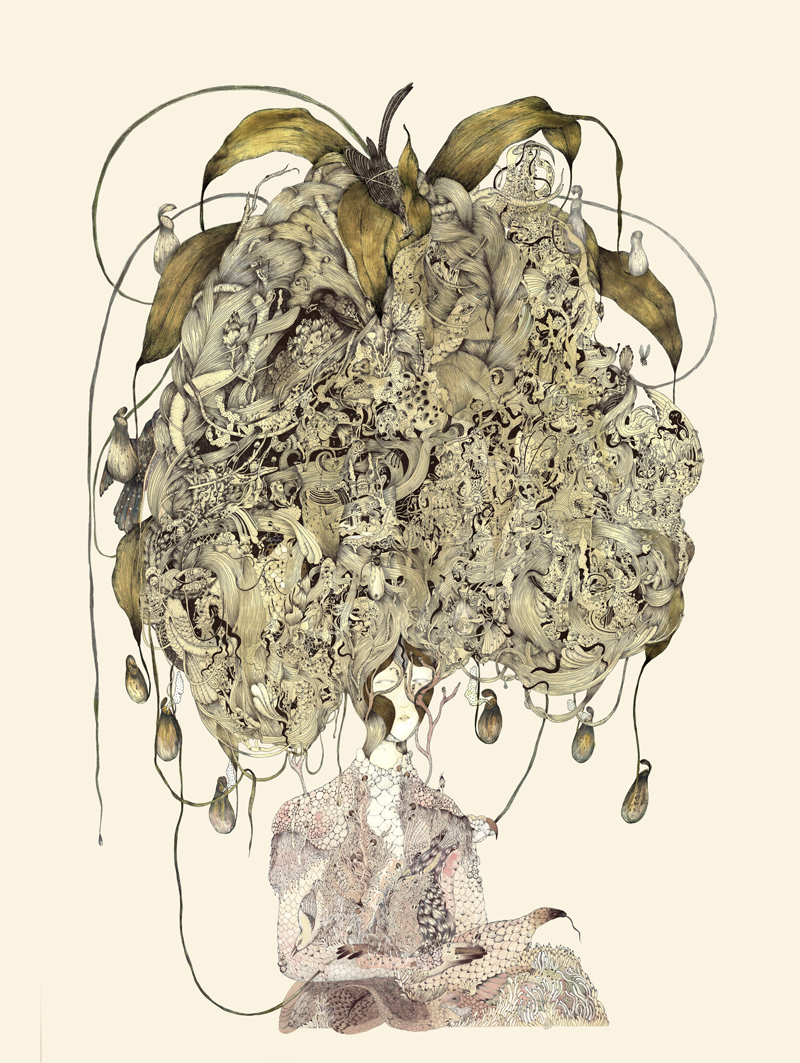
"Nepenthes"


"nepenthes" 
 acrylic,watercolor,gold and ballpoint pen on paper 
 841 x 1189 mm

Nepenthes, commonly known as pitcher plants, are a genus of carnivorous plants found primarily in tropical regions. 


They attract and trap insects and small animals with nectar and vibrant colors. The inside of the pitcher is slippery, causing prey to fall into the digestive fluid. Nepenthes can be found in a variety of habitats, including rainforests, heath forests, and mossy mountains.


Detail


Tuesday, December 17, 2013

Allegory of Chaos "detail"


"Allegory of Chaos"
acrylic,gold and ballpoint pen on paper 
841 x 594 mm 

Tuesday, December 10, 2013

"Panacea"

Panacea, in both myth and symbolism, represents the universal cure—a remedy that can heal all ailments, whether physical, emotional, or spiritual. 

In Greek mythology, Panacea was the daughter of Asclepius, the god of medicine, and was said to possess the knowledge and power to cure any disease. Her name itself, derived from the Greek word "panakes," means "all-healing," and she was revered as a symbol of hope and restoration. 


The image of Panacea often evokes a sense of ultimate healing, a figure that transcends the limits of time, place, and condition, offering solutions to life's many struggles.


2013
ink,acrylic,watercolor

Thursday, March 07, 2013

"Simurgh" new drawing

Persian Mythology: The Beneficial Simurgh


In the rich tapestry of Persian mythology, the Simurgh stands out as a creature of great benevolence. 

Unlike some of its trickster counterparts, such as Pazuzu and Imdugud/Anzu, the Simurgh is a bird-being that is highly regarded for its healing powers. While often compared to a phoenix, the Simurgh is also depicted as having the body of a lion, wings, and a bird's beak.


According to legend, just a touch from the Simurgh or one of its feathers could heal a person instantly. In addition, the Simurgh is believed to have knowledge of a special restorative brew called houma.

Persian myth recounts that the Simurgh lived in the Tree of Knowledge, which connects it to the myth of the Anzu, a creature that made its nest in the Huluppu tree. It is said that when the Simurgh took flight, the power of its ascent shook the tree's branches so violently that seeds from every plant that had ever existed were scattered throughout the world, bringing a wealth of valuable plants to humanity.


SIMURGH
ACRYILIC AND  BALLPOINT PEN  ON PAPER
42x59 cm
2013


Wednesday, October 17, 2012

Acherontia Medusa


Process


Reference


"Acherontia Medusa"
Ballpoint pen, acrylic, gold on paper
42x59cm


Saturday, September 08, 2012

Alecto

This is a detail from the final piece of my Furies series that I’ve been working on throughout this year. 

I must admit, interpreting emotions like pain, beauty, and the intense reactions we feel when betrayed has been a challenging process. However, in the end, the satisfaction of completing something that I find deeply enriching makes it all worthwhile. It was worth the journey!


Alecto

Alecto is one of the Furies in Greek mythology, known for her role as a relentless punisher of moral crimes, especially those related to anger and injustice. 

She is often depicted as pursuing wrongdoers with a whip, her anger never ceasing. Alecto's primary purpose is to avenge offenses such as personal insults, familial betrayal, and crimes against the gods. Her presence in myth highlights the inescapable nature of divine retribution. As one of the three Furies, she embodies the unyielding force of vengeance that seeks to restore balance through punishment.


Sunday, February 12, 2012

When Time Slows: Reflecting on the Invisible in My Work

 Finally, I’ve found a moment to sit and draw. Lately, everything’s been moving so quickly, and the rush has left little room for anything else. So having a bit of time to create something for myself, not for any commercial purpose, feels like a relief.


This drawing represents what’s invisible—how I feel when I stand in front of everything. It’s not a negative feeling, but I sometimes wonder: is it normal? Is it okay to feel disconnected, even from the success of my own work?


"Coracia"
Ballpoint pen, watercolor on paper


Saturday, November 05, 2011

Tisiphone

I began this piece during my trip to Athens. While browsing through a friend's library, I came across an incredible book that I’ll be sharing in the next few days. In it, I rediscovered the magnificent portrait A Young Lady by Petrus Christus, a work that has often inspired me. I felt it would be a great opportunity to reinterpret the beauty of this painting through my own lens.


Process


In the image below, my excitement led me to incorporate embroidery, a craft I first learned as a child. 

However, I quickly realized that the delicate details of the embroidery clashed with the complexity I intended for the hair. It turned out to be a bit of a miscalculation, and I ended up spending more time than I anticipated. Still, even though it didn’t quite work out as planned, it was a failure I can appreciate.


Tisiphone was one of the Erinyes or Furies, and sister of Alecto and Megaera. 

She was the one who punished crimes of murder: parricide, fratricide and homicide. A myth recounts how Tisiphone fell in love with Cithaeron, and caused his death by snakebite, specifically, by one of the snakes from her head.


Tisiphone

acrylic,gel ink , gold on paper
42x59,4
©Meyoko

Tuesday, December 28, 2010

Desired Constellation (New)

I just finished this cover for an underground French band called Jim Rose Expedition. The theme was "Expedition," but I’ve decided to call it Desired Constellation

This piece was inspired by my personal feelings about chagrin d'amour (heartbreak). It tells the story of a woman living in a wild, dark paradise, and a knight who discovers the key to her heart. 

However, she is cursed by a wicked witch (doubt), causing all potential suitors to be transformed into birds. From that moment on, like birds, they are destined to fly away, their hearts tethered only to the wind, never to return.


Desired Contellation x "L’Orée du Temps" album
ballpoint pen on Paper, 2010


Jim Rose Expedition


After self-producing their debut EP in January 2008, which quickly became a favorite on Fnac and Myspace, Jim Rose Expedition returns with L’Orée du Temps, a new EP recorded in some of Paris's top studios and released in mid-February.


You can listen the album here

Sunday, December 05, 2010

Desired Constellation (Progress)

I was recently approached by a French band, Jim Rose Expedition, who asked me to design the album cover for their upcoming release, L’Orée du Temps (The Edge of Time). 

I had so many ideas, but the word "expédition" (expedition) really stood out to me. I immediately thought, "I’ll definitely use some of Jules Verne's books as inspiration." Voyage au Centre de la Terre (Journey to the Center of the Earth), Cinq Semaines en Ballon (Five Weeks in a Balloon), and Le Voyage dans la Lune (A Trip to the Moon) by Georges Méliès all influenced the final design, especially the distinctive cover designs of the Hetzel editions, which guided my creative direction 

By merging these influences, I created a design that captures the essence of the band's spirit and vision, blending their unique musical identity with the theme of exploration.


Read More about Hetzel

Friday, September 10, 2010

The Republic of Utopia (NEW)


I’m excited to finally share that this piece is complete! After three months of work, I can honestly say that it has been one of the most enjoyable projects I've ever done.


This drawing is deeply inspired by the poetic and surreal worlds created by Jules Verne in Journey to the Center of the Earth, Bruno Schulz in The Republic of Dreams, and G. Garfield Crimmins' Republic of Dreams. Each of these authors helped shape the poetic backdrop of The Republic of Utopia, which combines elements of their dreamlike narratives. It’s important to note that Schulz’s Republic of Dreams has a darker undertone, which influenced my own creation.

 In The Republic of Utopia, I’ve mixed these authors’ visions with my own imprint. My villain, Ottomoon, is based on my father, similar to how Schulz portrays his father in his story. In my drawing, Ottomoon starts as a kind ruler, known for his love of nature and dance. 

However, his life takes a tragic turn when his beloved wife, a lovely peasant, is bewitched by the god of greed. Her personality, incompatible with greed, causes her to fall into an eternal sleep, driving Ottomoon mad. Consumed by grief, he becomes a tyrant—much like a Savonarola figure—punishing anyone who dares to create art or express themselves freely.


Greed Machine


Nureyev dancing


The Republic of Utopia 
Gel ink and ink on paper , 
 84,1 cm x 59,4 cm , 2010

Thursday, April 15, 2010

conspirationauroi1"conspiration au roi"

Followers